
Key takeaways:
- E-E-A-T is the most important consideration for content strategies in 2025.
- Website owners must ensure that their website displays all four indicators.
- Various content pieces both on and off site work together to establish E-E-A-T.
- Following this framework shows Google that your website adds value to its users.
In 2025, E-E-A-T should be at the center of every content strategy. This isn’t revolutionary, but it has become more important; now that mass-produced AI articles are overwhelming the content world, Google prioritizes content that addresses knowledge gaps and adds value.
E-E-A-T is its way of determining that.
So, how exactly can website owners display E-E-A-T, and what types of content should they be focusing on to bring people to their site? Let’s break it down.
E-E-A-T overview
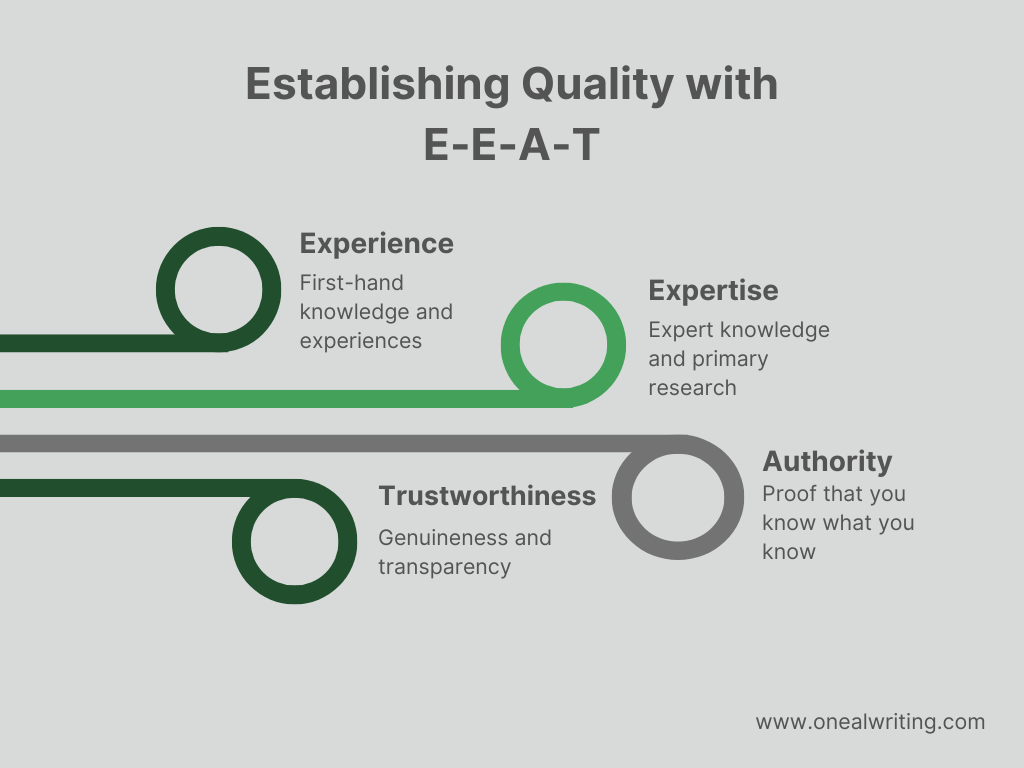
Experience, Expertise, Authority, and Trustworthiness are four evaluators that Google uses to determine if it wants to prioritize a website’s content.
- Experience = First-hand information and experiences. “I went on a hike. Here’s what it was like.”
- Expertise = Expert knowledge. “I’m a trail guide. Here are the things you need to know before going on a hike.”
- Authoritativeness = Proof that you know what you know. “Outside Magazine wrote an article that linked back to my trail guide website.”
- Trustworthiness = Authenticity and transparency. “Here are my citations to show my hiking article is accurate.”
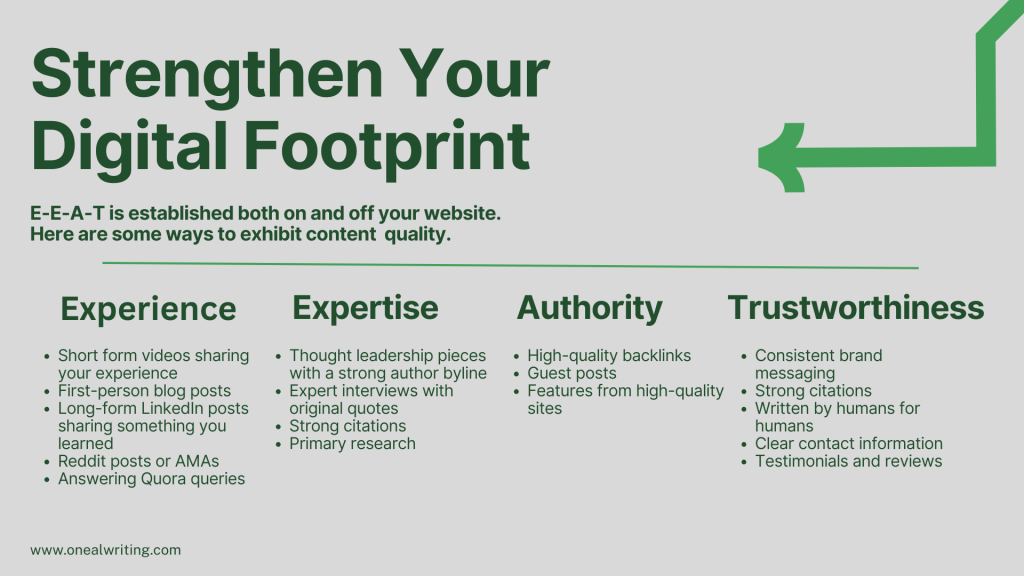
Not every article needs to display all four evaluators. Rather, they must be apparent in your entire digital footprint.
Demonstrating experience
“ I went on a hike. Here’s what it was like.”
The first E covers first-person experience. The person sharing their experiences doesn’t have to be an expert; they simply need to authentically share something they participated in.
Google wants to ensure that experience is genuine. As a result, we’re seeing posts from Reddit and Quora earning top SERP ranking, as Google assumes that the content on these sites is more likely to be authentic. Content marketers can leverage this by building a stronger presence on these sites or hosting AMAs.
Examples of experience-based content:
- Short form videos sharing your experience
- First-person blog posts
- Long-form LinkedIn posts sharing something you learned
- Reddit posts or AMAs
- Answering Quora queries
Showcasing expertise
“I’m a trail guide. Here’s what you need to know before going on a hike.”
Expertise is determined by whether you’re an expert in your field. Google wants to know that the content it prioritizes comes from organizations that know what they’re talking about. Websites need to cultivate content that has strong bylines and primary research to prove their expert knowledge.
Here are some ways to show expertise in your content:
- Thought leadership pieces with a strong author byline
- Expert interviews with original quotes
- Strong citations
- Primary research
Building authoritativeness
“Outside Magazine wrote an article that linked back to my trail guide website.”
Authoritativeness is indicated by others boosting your brand. This is primarily exhibited with high-quality backlinks.
Backlinks need to be authentically earned. You can do so by producing high-quality content that addresses knowledge gaps, promoting your content to high-quality websites, writing guest posts, appearing on podcasts, and otherwise networking with websites and content creators you’d like your website featured by.
Here are some ways to build authority with a backlinking strategy:
- Earn high-quality backlinks.
- Conduct a link audit to identify and remove low-quality backlinks.
- Guest post on high-level sites.
- Have high-level publications write about your company.
Improving trustworthiness
“Here are my citations to show my hiking article is accurate.”
Trustworthiness is perhaps the least tangible evaluator, but it’s equally important. It’s indicated by how reliable and consistent your content is overall.
To establish trustworthiness, you need consistent messaging, strong reviews, factual information, and clear authorship and contact details. Essentially, you need to make sure that everything is correct and genuine; your site shouldn’t have any misinformation, and you should remove all content that doesn’t align with your company and its brand.
Here are some ways to improve trustworthiness:
- Maintain consistent brand messaging.
- Cite your work.
- Don’t rely on AI to produce your content.
- Offer clear contact information.
- Show reviews and testimonials supporting your product and website.
Common E-E-A-T mistakes
Establishing all four evaluators isn’t easy. One of the biggest mistakes website owners make is trying to game the system. If you want your content to stand the test of time, you need to put in the effort to build authentic and credible content that Google loves to promote.
Here are some of the biggest mistakes to avoid:
- Ignoring content quality: Content needs to be well-written, well-structured, and digestible for your target audience. Expert authorship is only one SEO consideration; your content still needs to be readable. When establishing expertise, don’t sacrifice quality. Hiring a ghostwriter can help with this.
- Gaming the system: Participating in SEO strategies that attempt to take advantage of the rules will always lead to failure. You might see initial success, but inevitably, Google will roll out an algorithm update that will penalize your website or unindex it completely. The key to SEO success is authenticity.
- Over reliance on AI: LLMs do not stand up under any of the evaluators. You can use AI as a tool, but using it as a human replacement will kill your content.
- Neglecting user experience: Slow load times, bad site structure, and big blocks of text may increase your bounce rate, which indicates to search engines that your site may be low quality.
- Disregarding off-site content: User-generated content, off-site reviews, low-quality backlinks, and the way that others refer to your company and your site all contribute to your E-E-A-T. Make sure that you have strategies in place to manage your entire digital footprint.
So, what have we learned?
Since the dawn of SEO, keyword research has been the primary factor for success. Now, E-E-A-T has taken center stage. While keywords still have a place, website owners should first ensure that every piece of content establishes at least one of the four evaluators and that their digital footprint consists of ultra-high-quality content.
This may pose a challenge, but it’s also a huge opportunity to turn your website and brand into something extraordinary. It’s more than a marketing tool; exceptional content strategies can transform your company into an industry leader. Isn’t that better than slapping up blogs for the sake of posting? I think so.
If you’re ready to transform your brand with high-level content, let’s chat.
FAQ
What does E-E-A-T stand for?
E-E-A-T stands for Experience, Expertise, Authoritativeness, and Trustworthiness.
Why is E-E-A-T important?
E-E-A-T is perhaps the most important SEO consideration in 2025. It shows Google that your website is trustworthy and offers value to its users. Without E-E-A-T, your website will not earn top ranking.
Is E-E-A-T a direct ranking factor?
E-E-A-T is not a ranking factor at all. Rather, it’s an evaluator that Google users to determine if a website is high quality.
How can I improve E-E-A-T for my website?
- Carry strong author bylines.
- Ensure your content is well-written and easy to read.
- Earn high-quality backlinks.
- Maintain a strong digital footprint.
- Create consistent messaging.
- Conduct regular content audits to ensure your website is accurate and up to date.
 O'Neal Writing
Leave a comment